

Marketing can be a dirty word for many creatives.
For a lot of artists and community organizers, it can bring up images of men in suits, pointing at complicated charts while trying to squeeze more money out of people who already don’t have enough.
It makes sense that many creatives avoid it. Focusing on marketing can feel like playing into a system with an ethos you vehemently disapprove of.
But, at its core, marketing is just how we help people understand, experience, and engage with what we have to offer. It’s a framework for understanding how words and media can be combined to elicit a particular response in a group of people.
That means knowing how to use marketing is kind of like a superpower.
You can use it for good or evil.

The catch is that if you choose not to use it effectively, you’ll limit how far your work can go and how many people you’ll help through your community or organization.
What is marketing anyway?
When my daughter, Amy, was six, she asked me what I do for work. I had been working remotely as a marketer for a large-scale construction firm during the pandemic.
“I’m a marketer,” I said.
She frowned. “What’s that?”
Honestly, I had to think about it for a while.
Eventually, this is what I told her (paraphrased, of course):
I help people understand what my company does and show them how we can help them.
Imagine you made a really cool origami flower, but you kept it in your school cubby.
No one really knows you made it. Maybe they caught a peek when you grabbed your notebook, but they’re not sure what it even is.
But making origami is fun, so you want to share it.
The way you share it with your friends—that’s marketing. You’re showing them what you can do and telling them how they can be a part of it.
And if you teach them how to make it, that’s even better. They’ll be even more excited to make origami with you next time. That’s marketing, too. Now you’ve got five friends making origami, instead of just you.
That’s all marketing really is: making your work visible, understandable, and inviting enough that people want to engage with it.
If you’re doing great things and providing amazing services to communities, don’t hide it! Effective marketing means more people will be able to access your services, and your communities will grow.
Quick Example: How A Small Writing Workshop Community Grew Into An Annual Retreat
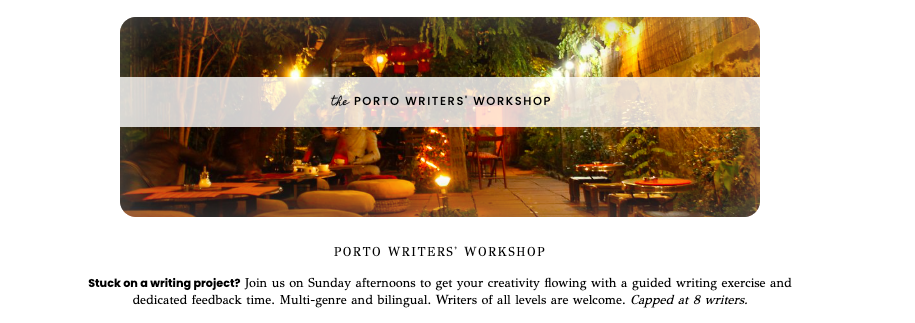
I moved to Porto in the summer of 2022 and almost immediately began missing my MFA writing community back in Florida. Then, I got lucky. The very first time I attended the local Just Write group, I met a friend who would help me create the workshop community I was missing.
We quickly set about figuring out how to create the Porto Writers’ Workshop: a writing community that was as open and accessible as possible. That meant allowing the group to be multi-genre, open to writers of all levels, and somehow, multi-lingual.
Ok, we figured out the structure, made a little banner, and put the event up on MeetUp.
Then…crickets.
Friends helped us share our brand new writing venture. But what really moved the needle in those early days was that other thing that scares introverts and creatives alike: networking. And—gasp—self-promotion.
Basically, we told everyone we could about it. We told bookshop owners, we told fellow writers, we told friends, and we told readers and yogis and people who love tea.
(You really never know who’s secretly a writer.)
This is the part that most people avoid. But it’s often what makes the difference between existing and growing, especially in a project’s early days.
Our first workshop had four people. And two of us were hosts. But over time, steadily, our little group grew to over 60 writers working in half a dozen languages. By the spring of 2025, it became clear there was enough interest for more. That’s how the Entrelinhas Retreat was born.
This is what marketing looks like in practice. In our example, the workshops functioned as a TOFU strategy. No, not the bland protein. TOFU is shorthand for top-of-funnel marketing. It’s representative of those first contacts your potential client has with your brand, otherwise known as the “Awareness” stage. Our PWW sessions could be seen as a gateway to our group’s other, higher-commitment offerings, like the retreat.
TOFU or Top-of-Funnel refers to the awareness stage of the marketing funnel. It’s the first point of contact a potential stakeholder or client has with your brand. TOFU strategies focus on education rather than on selling services. A good top-of-funnel strategy gets people excited about your organization and wanting to know more.
How do we know that the workshops worked as a TOFU strategy? That’s easy. When we launched Entrelinhas, 70% of tickets were sold within the first 48 hours. We sold out a few months later, with only 23% of attendees having come from outside our Porto workshop community.
You Can Use TOFU Strategies, too
If you’re stuck trying to market a higher-commitment service for your organization or artistic practice, ask yourself this: What’s the easiest thing I can do to make people more aware of my services?
Usually, this takes the shape of an entry-level industry mixer, webinar, educational content on a website or social media, or a quick introductory call where you show your potential clients what you can do specifically for them.
Whatever you do, just make sure it’s not bland.

OK, but how do I market my community or creative services responsibly?
Marketing responsibly means three things:
- It doesn’t cause needless waste. If there’s no need for a thousand print flyers or thirty meals when there are only twenty confirmed attendees, skip it.
- It clearly and honestly describes what you offer. Offerings and services should be well-defined and transparently priced.
- It’s client-focused instead of sales-centered. Your marketing, as well as your business model, should focus on solving an existing client need, rather than a more sales-centric approach.
If you’re running an arts organization, a creative business, or building a community, you’re likely already following these three rules. But it never hurts to double-check your alignment.
Marketing for Arts Organizations and Cultural Services: A Game of Show and Tell
Arts and cultural organizations are often run on razor-thin labor. Everyone is wearing different hats to keep things operating smoothly. Often, the last thing on anyone’s mind is self-promotion or marketing for growth.
It can feel like it’s enough work to actually do the work of helping your clients and visitors. But with a little effort or outside help, you could reach even more people and potential donors.
Think of it as a game of show and tell. Just like in the story about my daughter’s origami, if she never takes her paper flower out of her backpack, she’s reaching an audience of one. As soon as she shows it to her friends and teaches them how to make them, that audience grows fivefold.
If you’re not sure what to showcase, think back to your yearly accomplishments. You can start here:
- How many workshops did you run this year?
- Did someone new gain a skill or opportunity through your work?
- What was your most sought-after service?
Now tie that metric into the story of how your work impacted even just one of your clients.
And voilá: you have a piece of shareable content that gets even more people interested in your work.
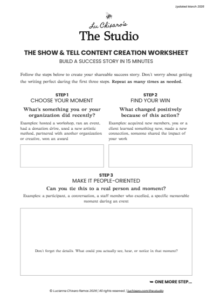
If you’re staring at a blank page trying to figure out how to turn your work into something shareable, I made a simple one-page worksheet to help you out. You can download it at the link below. No email required.
the show & tell content creation worksheet
Build A Success Story in 15 minutes
Marketing for Creatives: It’s Not Just About Social Media
If you’re a creative working in a visual medium, it can be tempting to stick to social media platforms, like Instagram, that reward aesthetically interesting images with follows and likes. But are those followers usually the ones purchasing your artwork or services?
If I had to hazard a guess, I’d say probably not.
The latest data published by Freelance Business, an online community providing educational support to Freelancers in Europe, shows that over 44% of freelancers rely on recommendations and referrals.
That means showing your face and staying top-of-mind to people who already know your work and are in your direct community.
The good news is that this doesn’t mean you have to sign up for every corporate networking session within a 20 km radius. Keep it simple and fun by attending two to three events each month and focusing on social industry events, as opposed to networking-style mixers. Think Lunch & Learns or informal drawing/writing/jam sessions.
And if there’s no bustling social scene for your industry or niche in your area? That’s when you can take the lead and start an easy-to-host meetup of your own. Starting your own group can help establish your credibility in your immediate community and beyond.
Oof, that’s a lot. What’s the best way to get started with arts marketing or marketing for my creative or community-building project?
Getting started with marketing can feel overwhelming. After all, it’s an entire field of study.
If you’re learning how to self-promote and market your services, be kind to yourself and start small. It’s not a practice that comes naturally to many freelancers or organizations working in the arts and cultural spaces.
Sit down with a cup of coffee and give the Show & Tell Content Creation Worksheet a try. Then make it a habit to fill it out and create one shareable story per week.
That’s how you start honing your newfound marketing superpowers.
You might not need an entire content calendar just yet, but with a little effort, you can start sharing your story and showing people exactly why your work is worth engaging with.

Hello? Operator?
Need marketing help that’s a little more…comprehensive?
I specialize in SEO and integrated content marketing strategies custom-built for arts organizations, creative tourism, and community-based projects.
And I’m only an email or call away.
Frequently Asked Questions
What is arts marketing, and why is it so important?
Arts marketing is the process of helping people discover, understand, and engage with your artistic work, organization, or events. For many arts orgs, marketing is the difference between doing great work in obscurity and actually reaching the communities that can benefit from it. When done well, arts marketing isn’t about using shady sales tactics. It’s about making your work visible and accessible to the right audience.
How is marketing for arts organizations different than traditional marketing?
Marketing for arts organizations is much more reliant on strong storytelling, whether that’s through visual media like video and high-quality photography shared on social, or through quality content writing that employs both narrative and SEO strategies. The idea is to transmit your impact with affordable but effective marketing strategies that build on your organization’s existing relationships.
What does digital marketing for creatives actually involve?
Digital marketing for creatives includes any online method used to share work and attract opportunities. That can mean your website, newsletter, social media, and any narrative content on your website. While platforms like Instagram can help with visibility and can be a great way to build location-independent connections, many creatives find that referrals and community connections are much more effective for acquiring new clients. If you’re not sure where to begin, feel free to reach out via email or set up a free consultation.
How can I use community-building marketing to grow my audience?
Community-building marketing is about creating experiences that bring people together, rather than just sharing content via websites or social media channels. This might look like hosting low-cost events, sharing behind-the-scenes content, or offering educational resources either in-person or online through webinars and live sessions. The goal is to create a natural pathway where people first engage with your work, then gradually become more interested and involved.
