

These days, it’s all about the receipts.
If you’re a creative freelancer or starting a community project or small business, you know firsthand the importance of client feedback. It’s not enough to have aesthetic photos, a prime location, or a decade of experience tucked away on your CV. People want the facts and figures—and, more importantly, they want your past clients to spill the tea.
That means getting customer reviews and testimonials should be one of your top priorities. But I know that when you’re in the throes of freelancing or starting a new business, asking for feedback is basically an afterthought. Like everything else about your business, getting feedback works better when it’s systematized.
First things first, though. Why should you care about asking for client feedback? Isn’t it awkward?
Well, yeah….sometimes. Unfortunately for the shy freelancers among us, social proof marketing is one of the best ways to attract new clients and grow your small business.
Want to skip the setup? You can copy my free customer feedback form template and adapt it for your own clients, workshops, or services. What is Social Proof in Marketing?
Social proof marketing is a marketing strategy that uses testimonials, reviews, ratings, and user-generated content to build trust and credibility. If you’ve ever decided to try a new café just because your friend posted a cute story about her €5 matcha latte or read a book because it had a 4.7 Goodreads rating, you’ve seen social proof in action.
Types of Social Proof Marketing
Many different types of content fall under the social proof marketing umbrella. Is your business making the most of your social proof?
- Customer reviews
- Testimonials
- Client logo displays
- User-generated content
OK, but how does that help me? Social proof only works for big brands, right?
Wrong. Very, very wrong.
(It’s OK, though. If you keep reading, you’ll still pass the class.)
According to a 2026 BrightLocal survey, 97% of consumers used customer reviews to decide whether to acquire services from a local business. So if you don’t yet have reviews or don’t showcase them prominently on your website or social media, you’re missing out on a huge chunk of credibility.
But how does a freelancer, solopreneur, or small biz get reviews anyway?
Asking for Client Feedback
How do small businesses and creatives get client feedback?
They just ask.
It’s really that simple. It’s the how and when you ask that gets tricky. Clients are busy—usually, you’re only one of their vendors. You’ll want to make it as easy as possible for the client to respond. That means, among other things, firing off that feedback request quickly after you complete the project.
What you decide to do with all this data later also plays a big role in whether social proof marketing works for your business. But more on that later.
For now, let’s take it step by step.
How to Ask for Client Feedback Without Being Weird
There are three simple ways you can ask a client for feedback as a freelancer or small business that won’t feel cringey:
- A brief email
- A rating on a relevant platform (i.e, Google Business, Reedsy, Goodreads, etc.)
- A client feedback form
Each of these options has its own benefits and drawbacks. What’s important to remember is that, regardless of the method, you’ll need to make a direct ask.
Sadly, no one is coming to your inbox unprompted to deliver a perfectly structured testimonial.
Rude, but true.
Option 1: Asking for Client Feedback via Email
Email is the simplest, fastest way to ask for feedback. It works especially well if you already have a warm relationship with the client, recently wrapped up a project, or just want a few sentences you can use as a testimonial.
The benefits of an email client feedback request:
- Email keeps things super simple.
- It feels personal, not like a mass ask.
- If you send it at project close-out, it feels like it’s just standard procedure.
The drawbacks of requesting feedback via email:
- Results may be inconsistent. Some clients may write three paragraphs, while others might just say, “Loved it. Thanks!”
- The data is hard to extract. Data you gather from email feedback is generally qualitative, unless you have a math-y client that answers with “10/10!”
A Quick and Easy Client Feedback Request Email Template
No need for a long preamble. Here’s an email template you can steal:
Hi [Client Name],

Thanks for trusting me with [project]. I really enjoyed working with you.

If you can spare a few minutes, I’d be grateful for a few lines of feedback about your experience. I’d like to know what worked well, what I could improve, and how satisfied you are with the services overall.

Please do let me know if I can use your feedback as a testimonial.

Looking forward to hearing your thoughts!

Best,

[Your Fancy Email Signature]
This works because it gives the client something to respond to. You are not just asking, “Any thoughts?”
Option 2: Asking for a Google Review or Another Platform Rating
Sometimes, what you need is not a long testimonial. You need a public review. Yes, the ones with the little gold stars.
This is ideal if you run a local business, host workshops or events, offer services through a platform, sell books, or work somewhere reviews are part of how people decide whether to trust you.
Think Google Business, Reedsy, Goodreads, Trustpilot, TripAdvisor, or whatever platform makes sense for your work.
The biggest benefit of asking for a platform review is visibility. A testimonial on your website is useful once someone gets there. A Google review can help them find you in the first place. Platform reviews also feel more credible because they’re on third-party sites.
The drawback is that a rating is often just that. There may or may not be an actual review attached to their 5/5 star rating. So while platform reviews are public-facing, they may not tell a potential client much about what makes your work so valuable.
Steal this Email Template to Ask for Platform Ratings Without Causing a Fuss
If you need to send a batch of platform review requests, copy and paste the template below so you can get back to doing what you really love:
Hi [Client Name],

Thanks for trusting me with [project]. I really enjoyed working with you.

If you can spare a couple of minutes, I’d be so grateful if you could leave a review here: [link to platform review site that leads directly to your page].

Thanks so much in advance. These ratings can really help a small business like mine!

Best,

[Your Amazing Email Signature]
See? Quick and easy. And at under 100 words, it’s a hard email to ignore.
Option 3: Using Client Feedback Forms
Of the three options, client feedback forms can have the biggest impact on your overall marketing strategy. From this one little form, you can extract data that will jazz up your elevator pitch and social posts for years to come.
A client feedback form gives you a repeatable structure. A.K.A., a system. In practice, the system should make things easier for you. A good feedback form gives you the chance to get usable testimonials, confirm sharing consent, and get ratings and other data, all in one go.
That will help you start to spot patterns.
All of this information is worth its weight in gold.
A good client feedback form can help you collect:
- Satisfaction ratings
- Recommendation scores
- Testimonials
- Stats for sales calls, pitches, and social posts
- Ideas for future offers
The trick is to keep the form short enough that people will actually complete it. If it looks like a personality test, dial it down by a few notches. Aim for three to five questions, max.
(There are a few exceptions to that five-question rule. I’ll cover that in my upcoming article: “Stats, Stats, Stats, Stats (Everybody!): How to Turn Your Reviews and Ratings Into Marketing Gold.”)
My Gift to You: A Free 3-Question Client Feedback Form Template That No One Says No To
Now, no more excuses.
I made you a client feedback form template you can copy, adapt, and send after your next project. Use it for freelance services, creative consulting, editing, coaching, design, workshops, strategy sessions, or any other service.
It’s the same Google Form I use to get feedback from my clients. I just toned down the Millennial humor a bit.
Access the form here or by clicking the banner below: Free Client Feedback Form Template.
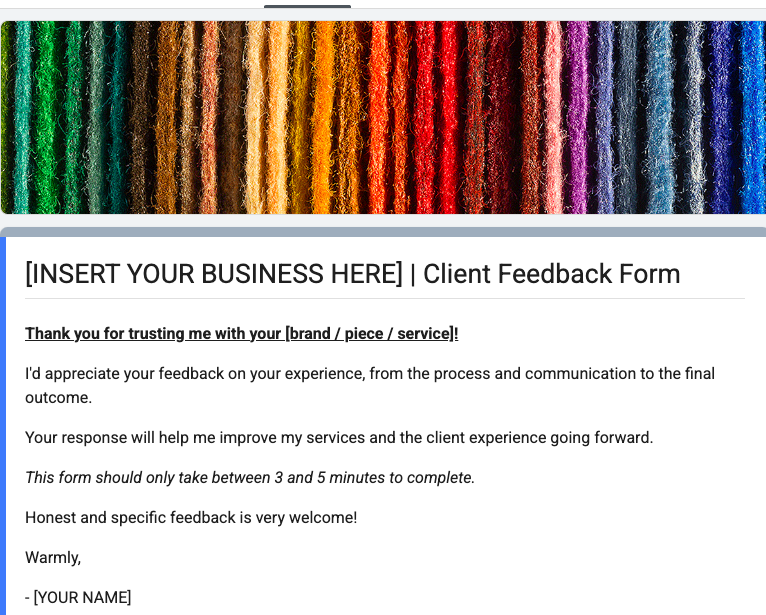
If you’re staring at a blank email trying to figure out how to ask for feedback, don’t stress! Just copy this free Google Form template.
Free Client Feedback Form Template
Start capturing data that you can actually use.
Now send off those request emails, sit back, and watch those glowing reviews pour in.